Best Fitness Trackers in 2026: The Honest Reviewer Consensus
Fitness trackers in 2026 have evolved well beyond a simple choice between a budget band and a premium smartwatch — the category now spans screenless sensors, smart rings, and AI-coached wearables that blur the line between health monitor and personal trainer. To cut through the marketing noise, we studied hands-on tests from TechRadar, Tom’s Guide, OutdoorGearLab, Android Authority, 9to5Google, Tech Advisor, WearableBeat, and Wareable, then mapped where independent reviewers converge and where they push back hard on each other.
The Short Version
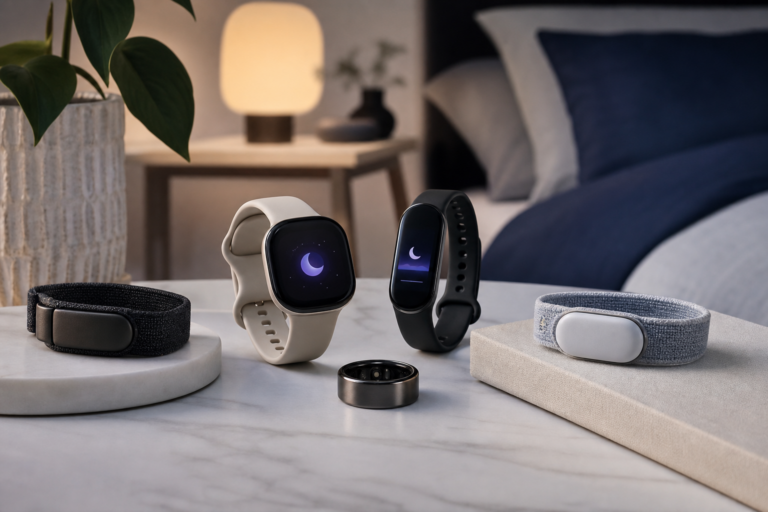
The Fitbit Charge 6 remains the consensus best traditional fitness band for most people. The brand-new Google Fitbit Air is the year’s most intriguing newcomer — hardware that genuinely impresses, AI that still needs work. The Garmin Vivoactive 6 is the sport-focused pick for buyers who want Garmin’s ecosystem depth at a sub-flagship price. Apple Watch Series 10 remains the most capable health device for iPhone users, battery life caveat firmly attached. And the smart ring category — led by the Oura Ring 4 and Samsung Galaxy Ring — has firmly cemented itself as a serious alternative to wrist-worn trackers.
2026 Fitness Tracker Comparison
| Device | Approx. Price | Battery Life | Best For | Sourced From |
|---|---|---|---|---|
| Fitbit Charge 6 | ~$120–$160 | 5–7 days | Health monitoring, sleep tracking | Tom’s Guide, WearableBeat |
| Google Fitbit Air | $99 | ~7 days (claimed) | Screenless / minimalist wearers | Android Authority, 9to5Google |
| Garmin Vivoactive 6 | ~$300 | Up to 11 days | Everyday athletes, road runners | OutdoorGearLab, TechRadar, Wareable |
| Apple Watch Series 10 | ~$399 | ~18 hours | iPhone users, medical-grade features | NBC Select, MedGrade |
| Samsung Galaxy Ring | ~$299 | 6–7 days | Subscription-free smart ring | Tech Advisor, TechRadar |
| Oura Ring 4 | ~$349 + $5.99/mo | 7–8 days | Sleep-first health tracking | Tech Advisor, Wareable |
| Amazfit Active 2 | ~$99–$129 | ~10 days | Budget GPS with offline maps | Tom’s Guide, Tech Advisor |
What the Reviews Agree On
The Fitbit Charge 6 is the safest all-round choice
Tom’s Guide, WearableBeat — which scored it 81 out of 100 — and multiple health-focused roundups all settle on the Fitbit Charge 6 as the best traditional fitness tracker for most people in 2026. Reviewers across outlets consistently praise its comprehensive sleep analysis covering stages, breathing rate, and skin temperature, its Google ecosystem tie-ins including Maps, Wallet, and YouTube Music, and its solid heart rate accuracy during steady-state exercise. WearableBeat specifically highlights the return of a physical side button as a meaningful fix after widespread frustration with the Charge 5’s touch-only navigation.
Apple Watch is unbeatable — within Apple’s ecosystem
Every major roundup that covers Apple treats the Series 10 as the ceiling for consumer health wearable sophistication. NBC Select and MedGrade both highlight its FDA-cleared ECG, its sleep apnea detection, and the Vitals overnight health dashboard as features that no traditional band can match. The caveat is repeated consistently across every outlet: battery life of roughly 18 hours means daily charging is non-negotiable — a dealbreaker for multi-day travellers, a total non-issue for anyone already accustomed to a nightly charging routine.
Smart rings have arrived as a genuine category
Tech Advisor and Wareable both give the smart ring segment serious treatment in 2026, no longer framing it as a novelty or an experiment. Tech Advisor names the Oura Ring 4 the best overall ring for its app depth and sleep staging accuracy — citing external research showing “good agreement” with clinical sleep studies — while naming the Samsung Galaxy Ring the top choice for anyone who refuses a monthly subscription. Both outlets agree that the ring form factor eliminates display fatigue and is particularly effective for passive, 24/7 background monitoring throughout the day and night.
AI coaching is the year’s most overhyped feature
The Google Fitbit Air’s Gemini-powered Health Coach is the boldest new pitch of 2026, and both Android Authority and 9to5Google — which each spent time with the device following its May 2026 launch — converged on the same concern: the AI is not yet reliable. Android Authority flagged “generic recommendations” that failed to contextualise the user’s actual data, while 9to5Google documented a more alarming failure: the coach generated a detailed summary of a 5.2-mile run that never took place, a phantom workout that “continued to exist within the layout” with no underlying record to support it. Both reviewers explicitly advise skipping the paid Health Coach subscription tier until Google addresses these reliability problems.
Optical wrist heart rate fails during weight training — on every brand
Tom’s Guide and WearableBeat both flag independently, without apparent coordination, that optical wrist-based heart rate monitoring degrades significantly during resistance training when wrist movement distorts the sensor’s light signal. Crucially, both make clear this is not a brand-specific problem: it applies equally to Fitbit, Garmin, and Apple hardware. Both outlets recommend a dedicated chest strap for anyone whose training priorities include accurate gym session data.
Where They Disagree
Is the Fitbit Charge 6 GPS good enough — or effectively broken?
This is the sharpest divide in 2026 fitness tracker coverage. WearableBeat’s detailed review reports that the built-in GPS “struggles to maintain satellite lock” unless the band is worn uncomfortably loosely, making it unreliable for any runner who cares about accurate pace and route data. Tom’s Guide takes a more forgiving position, treating the GPS as adequate for casual outdoor use. Wareable explicitly steers performance-focused buyers away from the Charge 6 and toward Garmin alternatives. The Charge 6 is not in dispute as a health and sleep monitoring device — the disagreement is entirely about whether GPS-dependent use cases can be part of its pitch.
Oura Ring 4 versus Samsung Galaxy Ring: no clear universal winner
Tech Advisor names the Oura Ring 4 the best overall ring for health insight depth and app quality, but simultaneously names the Samsung Galaxy Ring the better choice for most buyers thanks to its subscription-free model. Wareable leans toward the Oura for sleep data accuracy, backed by clinical validation it considers more rigorous. The practical complication flagged by Tech Advisor is that the Galaxy Ring’s tracking performs best within Samsung’s own ecosystem — stress tracking in particular shows erratic results without Galaxy Watch pairing. Neither outlet can name a clear universal winner without knowing the buyer’s phone platform and willingness to pay ongoing fees.
Is the Garmin Vivoactive 6 a value pick or a list of compromises?
OutdoorGearLab, which conducted a structured thirteen-device GPS watch test, ranked the Vivoactive 6 ninth overall and awarded it “Best on a Tight Budget” — a commendation that implies limits as much as praise. The lab dinged its single-band GPS for drifting under dense tree cover and characterised battery life as modest relative to the competition. TechRadar’s headline, meanwhile, called it a “feature-stuffed pocket rocket,” which reflects an enthusiasm the benchmark numbers only partially justify. Wareable and Tom’s Guide sit closer to TechRadar’s tone. The divergence tracks cleanly with audience: trail runners will expose its GPS ceiling; road runners and gym users are unlikely to ever notice it.
Amazfit Active 2: remarkable value or accuracy you cannot trust?
Tom’s Guide was enthusiastic, noting it packs features — offline maps, 160 sport modes, a full-week battery — that no other device approaches at under $100. A 16-month ownership assessment published by Smartwatch Sphere complicates that picture, documenting heart rate readings that ran consistently higher than Apple Watch benchmarks during workouts and a charging puck the reviewer described as finicky over time. Tech Advisor’s six-month review sits in between, endorsing it as a great budget smartwatch while confirming the absence of NFC payments and onboard music storage. The reviewers agree it over-delivers on feature count at its price; the disagreement is over whether the accuracy trade-offs matter to the likely buyer.
FAQ
Do I need a paid subscription to get useful fitness tracker features?
Not always. The Fitbit Charge 6’s core activity and heart rate monitoring works without a subscription, though WearableBeat notes that Sleep Profile, Daily Readiness Score, and deeper wellness reports sit behind the $9.99/month Fitbit Premium tier. The Samsung Galaxy Ring carries no subscription requirement at all, which Tech Advisor highlights as its strongest differentiator from Oura. The Oura Ring 4 requires a $5.99/month membership to access most of its health insights beyond basic movement counting. Garmin’s ecosystem, including the Vivoactive 6, keeps the majority of its features accessible with the hardware purchase alone.
Which fitness tracker is best for sleep tracking?
Tech Advisor and Wareable both point to the Oura Ring 4 as the strongest dedicated sleep tracker in 2026, citing its validation against clinical polysomnography studies for deep sleep staging accuracy. Among wrist-based trackers, the Fitbit Charge 6 is the consistent second-best option, analysing breathing rate, heart rate variability, skin temperature, and movement simultaneously through the night. Both the Oura and the Charge 6 require a subscription to unlock the most detailed sleep reports.
Is the Google Fitbit Air worth buying in 2026?
The hardware has won early reviewers over: Android Authority’s Kaitlyn Cimino noted she had “repeatedly forgotten” she was wearing it — high praise for any wrist device. At $99 with no mandatory subscription for core tracking, the value proposition for minimalists is genuine. The firm caveat from both Android Authority and 9to5Google is to avoid the paid Gemini Health Coach add-on until Google resolves the AI’s reliability issues, which currently extend to fabricating workout summaries for exercise sessions that never happened.
What is the best fitness tracker for serious runners?
For road runners working with a roughly $300 budget, OutdoorGearLab’s structured testing points to the Garmin Vivoactive 6, while noting its single-band GPS is a limitation under heavy tree cover. WearableBeat and Wareable both direct performance-focused runners toward the Garmin Forerunner 165 if consistent GPS lock is the priority — the Fitbit Charge 6’s GPS was found too inconsistent for that use case. Apple Watch Series 10 handles structured run tracking well within its roughly 18-hour battery window but is impractical for multi-hour events.
Are smart rings accurate enough to fully replace a wrist tracker?
For passive 24/7 monitoring — resting heart rate, sleep staging, recovery scores, and skin temperature trends — Tech Advisor and Wareable both find the Oura Ring 4 and Samsung Galaxy Ring are fully capable replacements for a traditional wrist band. For active workout tracking, most reviewers note that rings lack built-in GPS and show greater variability during high-intensity movement compared with wrist sensors. A smart ring is best understood as a replacement for a health and lifestyle band, not as a substitute for a dedicated GPS sports watch.
Sources
- androidauthority.com
- 9to5google.com
- outdoorgearlab.com
- wearablebeat.com
- techadvisor.com
- techradar.com
- tomsguide.com
- wareable.com
Related Articles